

Most sellers find out their main image is weak the expensive way: they ship it, run PPC behind it, watch ACOS climb for a month, and only then suspect the image. By that point you've spent thousands proving in production what a $50 test could have told you in 24 hours.
"What if sales don't grow?"
The fear behind every listing-design decisionThat's the objection sitting behind every listing-design decision — the fear of spending money on a change that doesn't pay off. PickFu is how you kill that fear with data before you commit ad budget. It puts your main image in front of real shoppers, asks which one they'd buy, and gives you a statistically-backed answer in a day. Here's how to use it to know your winner before Amazon's algorithm — and your PPC budget — finds out for you.
What PickFu Actually Is (and Why Sellers Use It)
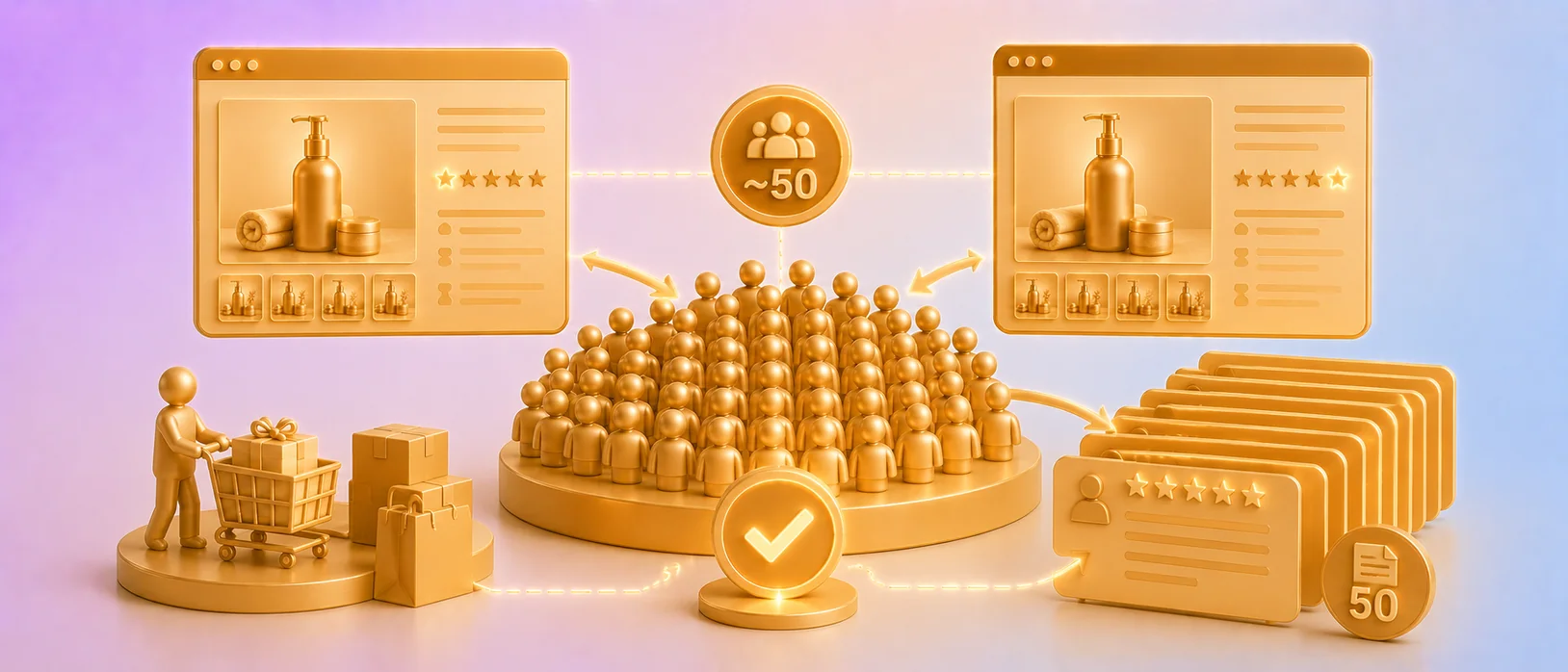
PickFu is a consumer-polling tool. You upload two (or more) versions of an image — say your current main vs a new one — and PickFu shows them to a panel of real US consumers, matched to a demographic if you want. Typically 50 respondents, ~$50, results in under an hour to 24 hours.
Each respondent picks the version they'd buy and — this is the valuable part — writes why. You don't just get "Version B won 68% to 32%." You get 50 short explanations of what made them choose, in buyers' own words.
Why sellers across r/FulfillmentByAmazon, Helium10, and the MyAmazonGuy crowd use it: it replaces opinion with data. No more "I think this looks better" or "let me ask my wife." You get a buyer verdict before you spend a dollar on ads behind the image.
"Let me check on PickFu / ask my wife."
Not a stall — the right instinct, turned into a 24-hour answerThe mistake is not testing and shipping on gut. PickFu turns the instinct to validate into a 24-hour, $50 answer.
Why Test the Main Image Specifically
Of everything you could test, the main image has the highest ROI per test, because it's the single highest-leverage asset on your listing:
- It drives CTR — the click in search results that determines whether you get sessions at all.
- It anchors the first impression that sets up CVR on the page.
- It influences PPC efficiency — a higher-CTR main lowers your effective CPC and ACOS.
- It compounds into organic rank and BSR through the velocity better CTR/CVR generates.
One image, tested for $50, drives the metric that drives everything downstream. That's the best test-dollar-to-impact ratio in listing optimization. Test the main first, always.
The Core Value: Test Before You Spend, Not After
Here's the reframe that makes PickFu worth it. There are two ways to find out if a main image converts:
The expensive way (live, after): ship the image, run PPC, accumulate a month of CTR/CVR data, infer whether the image is the problem, then rebuild and repeat. Cost: thousands in ad spend, a month of lost time, and the rank damage from running a weak listing live.
The cheap way (PickFu, before): test the image against alternatives for $50, 24 hours, ship the winner. Cost: $50 and a day.
The difference isn't just money — it's sequence. Testing before you spend means your PPC budget only ever runs behind a validated image. You stop paying Amazon to A/B test your creative for you at production prices. This is loss aversion working in your favor: the $50 test is cheap insurance against the four-figure loss of running an unvalidated image live.
"I spent $5k on PPC last month and broke even. Realized my main image looks like trash next to competitors."
The entire outcome a $50 PickFu test preventsThe seller spent $5k to learn what a poll would have told them for $50 — before the spend.
How to Run a PickFu Test That Actually Tells You Something
A bad test gives you a confident wrong answer. Here's how to run one that's decision-grade:
Don't test your new image against a blank. Test it against your current main image (am I actually improving?) and/or your top niche competitor's main (can I win the real comparison the buyer makes?). Testing against your competitor is the most honest test — it mirrors the actual 1.2-second comparison happening in search results.
The wording decides the value. Don't ask "which looks better?" — that measures aesthetics, not conversion. Ask the intent question: "Which [product] would you buy and why?" or, for spec/scale categories, "Which looks more durable/effective/right-sized?" "Looks better" and "I'd buy it" are different answers, and only one pays.
PickFu lets you target demographics. Match your actual buyer (e.g., women 25–45 for a beauty SKU, pet owners for pet gear). A verdict from the wrong audience is noise.
The 68/32 split tells you which won. The 50 written comments tell you why — and that's the part you act on. "I'd buy B because I can actually tell how big it is" is a direct instruction: scale was the deciding factor. Patterns in the comments are your design brief, in buyers' words.
80% of buyers are on a phone. PickFu can show the mobile thumbnail view — test how the image reads at the size buyers actually see it, not at full desktop resolution.
How to Read the Results Like a Seller, Not a Designer
A few rules for turning a poll into a decision:
- Margin matters more than the winner. A 52/48 split isn't a real win — it's a coin flip; neither image is decisively better. A 70/30 split is a clear signal. Look for decisive margins before you commit.
- The comments override the score when they conflict with your assumptions. If your image "won" but every comment says "I almost picked the other one because it showed the size," you have a fixable weakness even in the winner.
- Inconclusive is a result. A near-even split tells you neither image is winning the buyer — so you don't have your answer yet and shouldn't ship either as final. Worth knowing before you spend on ads.
- One decisive test beats ten gut decisions. The point isn't endless testing; it's replacing the guess with one clean data point on your highest-leverage asset.
Why This Defuses the Real Objection
The fear behind every design purchase is regret aversion: "I'll spend the money and it won't grow sales — or it'll get worse." PickFu is the structural answer to that fear, because it moves the proof before the spend:
- You don't hire on faith — you validate the new image against your current one first.
- You don't run ads behind an unproven image — you run them behind a buyer-validated winner.
- You don't find out it didn't work after $5k — you find out it works (or doesn't) for $50.
This is also why a competent specialist builds testing into the process. The seller's question "what if it doesn't work?" gets answered with "we'll PickFu it against your current image — if the new one doesn't win, we revise." That's not a guarantee of outcomes; it's a guarantee of validation, which is the honest version of de-risking the decision.
PickFu Tests the Image — But You Still Need an Image Worth Testing
Here's the limit sellers miss: PickFu tells you which image wins. It doesn't make the winning image. If you test two mediocre images, you learn which mediocre image is less bad — and ship a loser anyway.
"Hired someone on Fiverr for $80. The images looked nice but my conversion actually dropped."
PickFu only catches this if you have a stronger alternative to test againstTesting a weak Fiverr image against your current weak image just picks the lesser weak option. The test is only as good as the best image in it. You need a genuinely strong contender — built with category research, mobile-first, objection-killing — and the test to prove it won. The test and the image are two halves of the same job.
The sophisticated play: build a strong, strategy-driven main image, then PickFu it against your current one and your competitor's to prove it wins before you spend. Image quality and validation together — that's how you know, not hope.
FAQ
- What is PickFu and how does it work for Amazon main images?
- PickFu is a consumer-polling tool that shows two or more images to a panel of real US shoppers (typically 50 respondents, ~$50, results in under 24 hours). Each respondent picks the version they'd buy and explains why, giving you a statistically-backed verdict on which main image converts better — before you spend on PPC behind it.
- Why should I A/B test my Amazon main image before running ads?
- Because the alternative is finding out the expensive way: shipping the image, running PPC, and watching ACOS climb for a month before suspecting the image. A $50 PickFu test gives you a buyer verdict in 24 hours, so your ad budget only ever runs behind a validated image instead of paying Amazon to A/B test your creative at production prices.
- How do I run a PickFu test that gives a reliable result?
- Test your new image against your current main and/or your top competitor's main; ask the buying question ("which would you buy and why?") not "which looks better"; match the audience to your actual buyer demographic; read the written comments, not just the score; and use the mobile thumbnail view since 80% of buyers are on phones.
- How do I read PickFu results correctly?
- Look at the margin, not just the winner — a 52/48 split is a coin flip, while 70/30 is a decisive signal. Read the written comments to learn why one won, which is your actionable design brief. Treat a near-even split as "inconclusive," meaning you don't yet have a winner and shouldn't ship either as final.
- Does PickFu guarantee my Amazon sales will improve?
- No — PickFu validates which image buyers prefer, but it doesn't create a winning image. If you test two weak images, you only learn which is less weak. You need a genuinely strong contender (built with category research, mobile-first, objection-killing) and the test to prove it wins. The test and the image quality are two halves of the same job.
Want your image to win the PickFu test before you pay for it? Free.
Send your ASIN — we'll rebuild your main image at no cost: mobile-first, TOS-compliant, built to win the buyer comparison. Then test it. If it doesn't beat your current image in a PickFu A/B against your niche leader, you owe nothing — a validated winner before you commit, not a guess you pay for.
Claim my free image →