
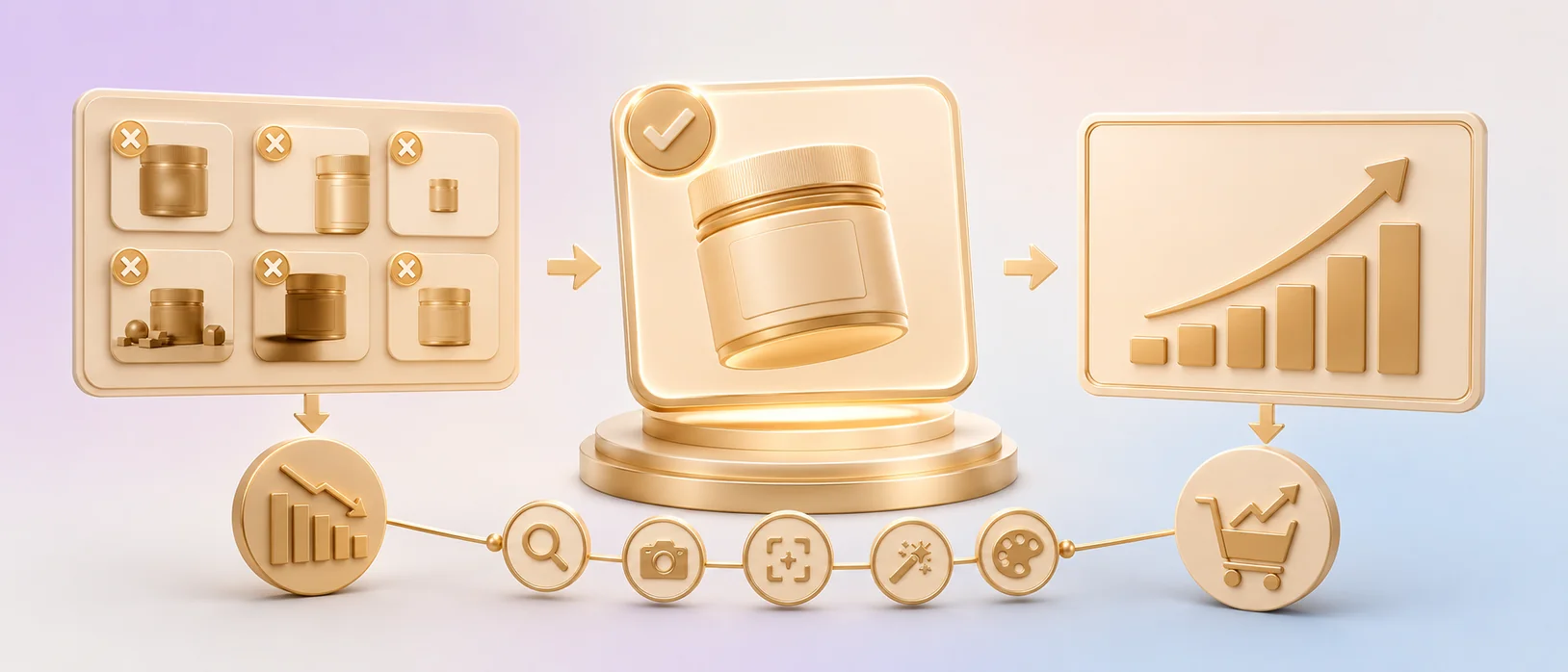
Open Seller Central, pull up Search Query Performance, and look at your click-through rate. If your CTR is sitting under 0.3% on your main keywords while competitors rank above you, you're not running a traffic problem. You're running an image problem.
Here's the part that costs sellers the most money: low CTR doesn't just mean fewer clicks. It feeds the algorithm. Amazon reads weak CTR as "buyers don't want this listing," buries you lower in search, and forces you to buy back the visibility with PPC. Your ACOS climbs to cover a hole your main image dug.
"A competitor with a worse product is outranking you. Want to know why?"
Their photos. That's almost always the answer. Let's break down exactly why your CTR is low and what the main image has to do to fix it — in seller language, no fluff.
What Counts as "Low" CTR
CTR varies by category, but here are working benchmarks for Sponsored Products and organic search tiles:
- Under 0.3% — you have a main-image problem. Full stop.
- 0.3%–0.5% — below average; you're leaving clicks on the table.
- 0.5%–0.8% — solid; optimize for incremental gains.
- 0.8%+ — strong; protect it and focus on CVR.
The number that matters isn't CTR in isolation — it's CTR relative to the tiles next to you in the same SERP. If the niche leader is pulling 0.7% CTR and you're at 0.25%, you're getting roughly one-third of the clicks per impression on the same traffic. On a keyword driving 50,000 impressions/month, that's the difference between 350 sessions and 125. Same traffic, three times the sessions, just from the tile.
Why CTR Drives Everything Downstream
Sellers obsess over CVR and ACOS but underweight CTR. That's backwards. CTR is upstream of both:
- Low CTR → low sessions. Fewer people click, fewer people land.
- Low sessions → weak velocity signal. Amazon's algorithm reads low engagement and deprioritizes your organic rank.
- Lower rank → fewer impressions on good keywords. You slide off page one for your money terms.
- You backfill with PPC. Now you're paying for clicks you used to get free. ACOS climbs.
- Higher ACOS → thinner margin → less room to bid. The spiral tightens.
"I'm bleeding money on PPC."
Amazon seller communitiesThat's the most common pain point in the seller communities — and a huge share of it traces back to a main image that doesn't earn the click. You can't out-bid a bad CTR. You can only fix the tile.
The 6 Reasons Your Main Image Is Killing Your CTR
1. It Doesn't Read at Thumbnail Size on Mobile
80% of buyers are on a phone. Your main image is competing as a ~150-pixel thumbnail in a scrolling feed, judged in roughly 1.2 seconds. If your product detail, label, or value only reads on a desktop monitor, it's invisible where the clicks actually happen. The single most common CTR killer is an image designed for desktop and never QA'd at thumbnail size.
2. No Visual Hierarchy — The Eye Doesn't Know Where to Land
A cluttered or evenly-weighted image gives the scrolling buyer nothing to lock onto. The winning tile has one clear focal point that registers instantly: what it is, in one glance. If a buyer has to "figure out" your image, they've already scrolled past it.
3. Wrong Scale or Missing Context
Buyers under- and over-estimate product size constantly. If your tile doesn't communicate scale — relative to a hand, a standard object, a recognizable reference — buyers either skip it (looks too small/cheap) or click and bounce (looks bigger than reality, tanking CVR too).
4. It Looks Like a No-Name Next to Branded Competitors
On a feed full of tiles, the buyer's eye filters for "real brand." If your competitor's tile signals a branded, higher-tier product and yours looks generic, you lose the click before product quality even enters the equation. The buyer never finds out your product is better.
5. Poor Differentiation From the Tiles Around It
If your image looks like every other tile in the category — same angle, same white background, same framing — you blend into the feed and get scrolled past. Standing out (within TOS) is a CTR lever most sellers ignore because they copied the category template.
6. It's TOS-Compliant but Lifeless
A clean white-background shot that breaks no rules and earns no clicks. Compliance is the floor, not the goal. "Not suppressed" and "high CTR" are two different bars, and most sellers stop at the first one.

What a High-CTR Main Image Actually Does
Forget "looks good." A main image that lifts CTR does four specific jobs, in order, in about 1.2 seconds on a phone:
- Identifies the product instantly. Zero ambiguity at thumbnail size. The buyer knows what it is before they read a word.
- Communicates scale and key value. Within TOS limits — through the product shot itself, angle, and visible detail, not text overlays (which suppress the listing).
- Signals "real brand." Visible branding on the product, premium finish cues, the quality the buyer is scanning for.
- Differentiates from neighbors. A composition or angle that breaks the visual monotony of the SERP so the eye stops on your tile, not the one above it.
That's it. It's not art. It's a conversion tool that has one job: earn the click on a phone screen in a competitive feed.
How to Diagnose Your CTR Problem in 20 Minutes
Before you spend a dollar:
- Pull Search Query Performance in Seller Central. Sort by impressions. Find your top 5 keywords and note CTR on each.
- Search those keywords yourself on mobile. Screenshot the SERP. Put your tile next to the top 3 competitors at actual thumbnail size. Be honest: where does your eye go? If it's not your tile, that's your CTR gap, visualized.
- Run a PickFu poll. $50, 50 respondents, 24 hours. Show your main image against the top 2 competitors and ask "which would you click and why?" The verbatim feedback tells you exactly what your tile fails to communicate. This is the cheapest CTR research money buys, and it gives you proof before you redesign — so you fix the right thing.
Sellers who skip the diagnosis redesign toward "prettier" and wonder why CTR didn't move. The buyers in a PickFu poll will tell you what they actually couldn't see.
Why "Just Use Fiverr" Doesn't Move CTR
"Hired someone on Fiverr for $80. The images looked nice but my conversion actually dropped."
Amazon seller forumA generalist designer makes a "nice photo." Nice doesn't earn clicks in a competitive feed. CTR comes from category research (what the niche leader's tile does that yours doesn't), mobile-first composition (QA'd at thumbnail), and a focal point engineered for a 1.2-second scan — none of which an $80 gig includes. Worse, the "nice" version often adds a subtle text element or off-white background that gets the listing suppressed, taking your CTR to zero.
We're more expensive than Fiverr. The reason it pays back: a main image that lifts CTR from 0.25% → 0.6% on a keyword driving 50k impressions/month nearly triples your sessions from that term — and that compounds into better organic rank and lower ACOS across the whole listing. That's the math, and it's why the cheap option is usually the expensive one.
The Payback Math
Take one money keyword:
- Impressions/month: 50,000
- Current CTR: 0.25% → 125 sessions
- Improved CTR: 0.60% → 300 sessions
- At CVR 10% and AOV $30: +175 sessions × 10% × $30 = +$525/mo from one keyword
Now multiply across your top 5 keywords and add the organic-rank lift from improved velocity and the ACOS savings from needing less PPC to hold position. A main-image rebuild ($150–$400 from a specialist) pays back in days, then compounds. Doing nothing keeps the leak open every single day.
FAQ
- What is a good CTR on Amazon?
- A strong organic and Sponsored Products CTR is 0.5%–0.8%+, depending on category. Under 0.3% signals a main-image problem. What matters most is your CTR relative to the competing tiles in the same search results — if the niche leader pulls 0.7% and you pull 0.25%, you're getting roughly one-third of the clicks on the same impressions.
- Why is my Amazon CTR suddenly low?
- The most common causes are a main image that doesn't read at thumbnail size on mobile, no clear focal point, missing scale context, looking generic next to branded competitors, or blending into the SERP. A competitor refreshing their tile can also drop your relative CTR even if your image didn't change.
- How do I improve my Amazon click-through rate?
- Rebuild the main image to do four jobs in ~1.2 seconds on mobile: identify the product instantly, communicate scale and value within TOS limits, signal a real brand, and differentiate from neighboring tiles. Diagnose first with Search Query Performance data and a PickFu poll against your top competitors, then redesign toward what buyers said they couldn't see.
- Does the main image really affect Amazon ranking?
- Yes, indirectly but powerfully. The main image drives CTR; CTR drives sessions and sales velocity; velocity drives organic rank and BSR. A low-CTR tile signals weak demand to Amazon's algorithm, which deprioritizes the listing and forces you to backfill visibility with PPC, raising ACOS.
- Can I put text on my main image to improve CTR?
- No. Text, logos, and badges on the main image violate Amazon's product image policy and trigger suppression, which drops CTR to zero. CTR gains have to come from the product shot itself — composition, scale, focal point, and branding visible on the product — not from overlays. Text and infographics belong in image slots 2–7.
Stop guessing why your CTR is low. Get your first image free.
Send your ASIN — we rebuild your main image at no cost: mobile-first, TOS-compliant, engineered to win the click against your actual niche competitors. You see the new tile before you commit to anything else. If it doesn't beat your current image in a PickFu A/B, you owe nothing.
Claim my free image →