

You're searching "how to lower ACOS" because your PPC is eating your profit and you want it to stop. Almost every answer you'll find says the same things: lower your bids, add negative keywords, restructure campaigns, dayparting. All real tactics. All missing the biggest lever.
"I'm bleeding money on PPC."
The reframe that changes the mathHere's the reframe that changes the math: ACOS is not primarily a bidding problem. It's a conversion problem. You can spend weeks fine-tuning bids and shave a few points, or you can fix the one variable that moves ACOS more than any bid adjustment — the CVR of the listing your PPC traffic lands on. Most sellers optimize the campaign and ignore the destination. Let's fix that.
The Formula Nobody Reframes: ACOS Is Downstream of CVR
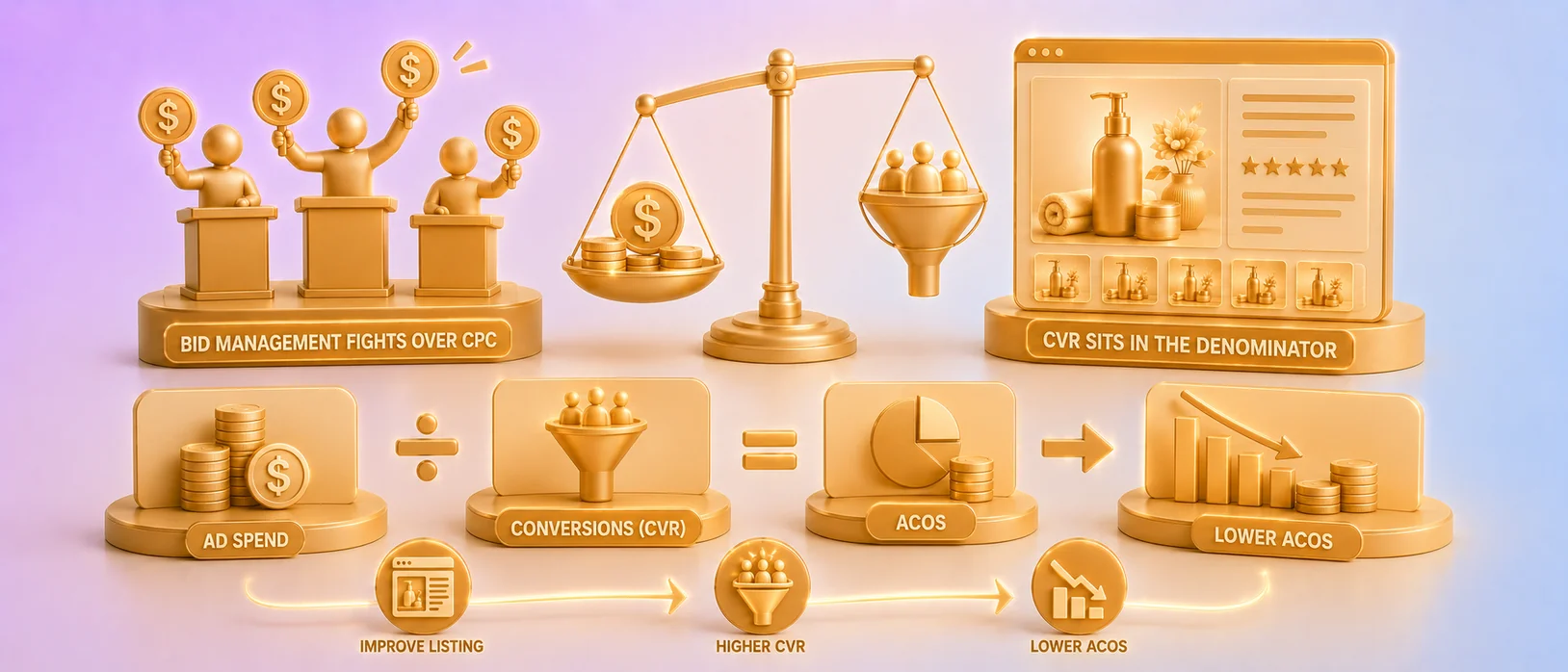
Start with the math, because it ends the debate. ACOS is ad spend ÷ ad revenue. Break it down to what you actually control:
Your ACOS is driven by three things: cost per click, conversion rate, and average order value. Bid management only touches the first one — CPC — and only at the margins, because the market sets the floor. But CVR sits in the denominator, and it's the variable with the most room to move.
You just cut ACOS by 27 points without touching a single bid. Same campaigns, same CPC, same keywords. The only thing that changed is the listing converted the traffic it was already paying for. No bid adjustment in the world matches that move, because bids fight over CPC while CVR has multiples of headroom.
Why Bid Management Hits a Wall
Bid optimization is real work and you should do it — but understand its ceiling:
- CPC has a floor. The market sets competitive bid ranges. You can trim, but you can't bid your way below what it costs to be visible in your category.
- Lower bids = lower placement = less traffic. Cutting bids to lower ACOS often just buys you less volume at a slightly better rate — you shrink the business to improve a ratio.
- Negatives and restructuring have diminishing returns. After the obvious waste is cut, you're optimizing decimals.
The wall is structural: bid management optimizes the cost side of the ACOS equation, which has limited room. The conversion side — CVR — is where the real leverage lives, and it's the side bid management can't touch. You don't fix a conversion problem with a bidding tool.
"I spent $5k on PPC last month and broke even. Realized my main image looks like trash next to competitors."
Diagnosed correctly — break-even was a listing problem, not a bidding oneThe break-even wasn't a bidding failure — it was a listing converting too low to make the ad spend pay. No campaign restructure fixes that. A better listing does.
The Diagnosis: Is Your ACOS a Bid Problem or a Listing Problem?
Run this check before you touch anything:
- Pull your CVR (unit session percentage) from Business Reports → Detail Page Sales and Traffic, for your PPC-heavy SKUs.
- Compare to category benchmark. Most categories run 10–20%. If you're below benchmark, your ACOS problem is a listing problem wearing an ad-spend costume — no bid change fixes a sub-benchmark CVR.
- Check the gap. If your CVR is at or above benchmark and ACOS is still high, then it's more likely a bid/targeting problem. If your CVR is below benchmark — which it usually is for sellers with climbing ACOS — the listing is your lever.
"Burning PPC, ACOS is climbing."
The trigger looks like bidding; the root cause is a listing falling behindWhen ACOS is climbing, it's often because a competitor refreshed their listing, their CVR rose, yours stayed flat, and now you're losing the relative conversion race — so you bid harder to hold position, and ACOS climbs. The trigger looks like a bidding problem; the root cause is a listing falling behind.
What Actually Lowers ACOS: Fixing the Destination
Your PPC click lands on a listing. That listing either converts the click (low cost per acquisition, low ACOS) or wastes it (high cost per acquisition, high ACOS). Here's what moves CVR on the destination:
Even on PPC, the click is influenced by your main image, and the buyer's first on-page impression sets the conversion tone. A main that signals "real brand" and matches the buyer's search intent primes the conversion. A weak one starts the session on the back foot.
On mobile — 80% of your paid traffic — buyers swipe images before reading text. Each image must defuse a specific doubt: scale, durability, what's included, how it compares to the cheaper option, who it's for. Every unanswered objection is a bounced paid click and a higher ACOS.
The #1 bounce driver in most categories is uncertainty the images don't resolve. Explicit scale, dimensions, and key specs convert the paid click instead of letting it bounce to a competitor.
PPC traffic is often comparison-shopping. A comparison image (vs the generic value tier, no named competitors — TOS) closes the buyer who'd otherwise leave to check a cheaper option — recovering the paid click.
If you have Brand Registry, conversion-focused A+ adds 8–15% CVR on average. That lift flows straight into the ACOS formula's denominator — lowering ACOS on the same bids.
Every one of these is a CVR lever, and every CVR lever is an ACOS lever, because of the formula. You're not "improving design" — you're lowering the cost per acquisition of traffic you're already buying.
The Compounding Bonus: Lower ACOS Funds Higher Rank
Here's why fixing the listing beats cutting bids, beyond the immediate math:
- Better listing → higher CVR → lower cost per acquisition → lower ACOS.
- Lower ACOS → you can now bid profitably for more traffic instead of cutting back.
- More converting traffic → stronger sales velocity → higher organic rank and BSR.
- Higher organic rank → more free traffic → less PPC dependence → ACOS drops further.
Cutting bids does the opposite — less traffic, weaker velocity, slipping rank, more PPC dependence later. Fixing the listing lowers ACOS and compounds into organic rank. Cutting bids lowers ACOS by shrinking. One builds the business; the other manages its decline.
This is loss aversion pointed the right way: every paid click bouncing off a weak listing is a booked loss you feel twice as hard as a gain — and the fix isn't spending less, it's stopping the leak.
Why "Just Lower the Bids" Is the Expensive Answer
"Hired someone on Fiverr for $80. The images looked nice but my conversion actually dropped."
The bidding-only and cheap-listing approaches make the same mistakeThe bidding-only approach and the cheap-listing approach make the same mistake from opposite ends: both ignore that CVR is where ACOS is won. Lowering bids shrinks your traffic to flatter a ratio. A cheap listing keeps CVR low so the ratio never improves. Neither fixes the destination.
We're more expensive than Fiverr, and more expensive than free bid-tweaking. But the comparison is stark: shaving bids might move ACOS 3–5 points by shrinking volume. Fixing a sub-benchmark listing can move it 20+ points while growing volume — because it attacks the denominator, not the numerator. On a $5k/mo PPC spend bleeding at 60% ACOS, that's the difference between a few hundred dollars saved by shrinking and thousands recovered by converting.
The Bottom Line: Optimize the Destination, Not Just the Campaign
You can spend your time in Campaign Manager fighting over CPC, or you can fix the listing that decides whether every click converts. The formula doesn't lie: ACOS = CPC ÷ (CVR × AOV), and CVR is the variable with the most headroom and the least competition for your attention.
Lower your bids if there's obvious waste. But if your ACOS is climbing and your CVR is below benchmark, the fastest, most durable way to lower ACOS isn't in your bid settings — it's in the images your PPC traffic lands on.
FAQ
- How can I lower my Amazon ACOS without lowering bids?
- Improve the conversion rate (CVR) of the listing your PPC traffic lands on. ACOS = CPC ÷ (CVR × AOV), so raising CVR directly lowers ACOS on the same bids. For example, at a $1.50 CPC and $30 AOV, lifting CVR from 8% to 14% drops ACOS from 62.5% to 35.7% — a 27-point cut with no bid change — by fixing the images, scale/spec clarity, comparison, and A+ that convert the click.
- Is high ACOS a bidding problem or a listing problem?
- Usually a listing problem. Check your CVR (unit session percentage) against your category benchmark of 10–20%. If you're below benchmark, no bid adjustment fixes the underlying low conversion — the listing is the lever. If your CVR is at or above benchmark and ACOS is still high, then bid/targeting optimization is more likely the fix.
- Why does cutting bids fail to fix ACOS?
- Because bid management only touches CPC, which has a market-set floor, and cutting bids lowers your placement and traffic — shrinking the business to improve a ratio. CVR sits in the ACOS denominator with far more headroom, and it's the variable bids can't touch. You can't fix a conversion problem with a bidding tool.
- Why is my ACOS climbing over time?
- Often because a competitor refreshed their listing, their CVR rose, yours stayed flat, and you're losing the relative conversion race — so you bid harder to hold position and ACOS climbs. It looks like a bidding problem but the root cause is a listing falling behind. Refreshing the listing to lift CVR addresses the actual cause.
- How much can a better listing lower my ACOS?
- Significantly more than bid tweaks. Shaving bids might move ACOS 3–5 points by reducing volume, while fixing a sub-benchmark listing can move it 20+ points while growing volume, because it raises CVR in the ACOS denominator. Lower ACOS also lets you bid profitably for more traffic, building sales velocity and organic rank that reduce PPC dependence over time.
Your bids are overpriced if the listing converts below benchmark. Fix it free.
Your PPC is sending paid traffic to a listing right now. Send your ASIN — we'll rebuild your main image at no cost: mobile-first, TOS-compliant, built to convert the traffic you're already paying for. You see it before you commit to a full set. If it doesn't beat your current image in a PickFu A/B against your niche leader, you owe nothing.
Claim my free image →