

Every new Amazon seller asks the same question: how do I find a winning product? They spend weeks in Helium10 and Jungle Scout hunting for the magic SKU — high demand, low competition, fat margins. And here's what almost nobody tells them: the product research is only half the job. The other half — the half that decides whether you actually win the opportunity you found — is the listing.
A "winning product" with a losing listing is a losing product. You can pick the perfect SKU, source it well, price it right, and still get buried by a competitor selling the same product with a listing that converts better. Product research finds the opening. The listing is whether you walk through it. Here's how to do both.
What Actually Makes a Product "Winnable" on Amazon
Forget the guru checklists for a second. A product is winnable when these conditions line up:
- Real, durable demand. Search volume that's stable or growing, not a fad spike. Check 12-month trends, not last month's hype.
- Competition you can out-convert. Not "low competition" (rare and usually a trap) — but competition with beatable listings. If the top sellers have weak images, that's your opening. If they're all professionally optimized, the bar is higher.
- Margin that survives PPC. A product where the unit economics hold up after $2–5 PPC clicks. If the margin can't absorb the ACOS to launch, demand doesn't matter.
- A differentiation angle. Something — a feature, a bundle, a use case, a quality tier — you can show in a listing to justify a price above the cheapest option.
- No TOS minefield you can't navigate. Categories like supplements/food carry claim risk; gated categories carry approval hurdles. Know what you're walking into.
Notice that two of the five — beatable listings and a showable differentiation angle — are listing factors, not product factors. The "winning product" question is half a listing question, and most sellers never realize it.
The Research Step Most Sellers Skip: The Listing Teardown
Standard product research stops at demand and competition numbers. The step that separates winners from the people who launch into a wall: tear down the top listings before you commit.
For your top 3–5 target competitors, open their listings on mobile and assess:
- Main image quality. Strong, or generic? Weak mains = beatable = your opening. Strong mains = higher bar.
- Infographic depth. Do they answer buyer objections, or just show the product? Gaps you can fill = your conversion edge.
- A+ Content. Present and good, or absent/weak? Missing A+ on top sellers = an easy advantage.
- Review themes. What do buyers complain about? Every complaint is a differentiation angle you can show in your listing.
"A competitor with a worse product is outranking you. Want to know why?"
Before you launch, this is a warning — and an opportunityIf a worse product is winning on a better listing, you can do the same in reverse: a comparable product with a better listing beats an entrenched competitor with a weak one. The listing teardown tells you whether the niche is winnable for you, specifically.
Why Design Decides the Winner (the Part Research Tools Hide)
Helium10 and Jungle Scout show you demand and competition. They cannot show you the thing that actually decides the sale: which listing converts the traffic. Here's the mechanism research tools hide:
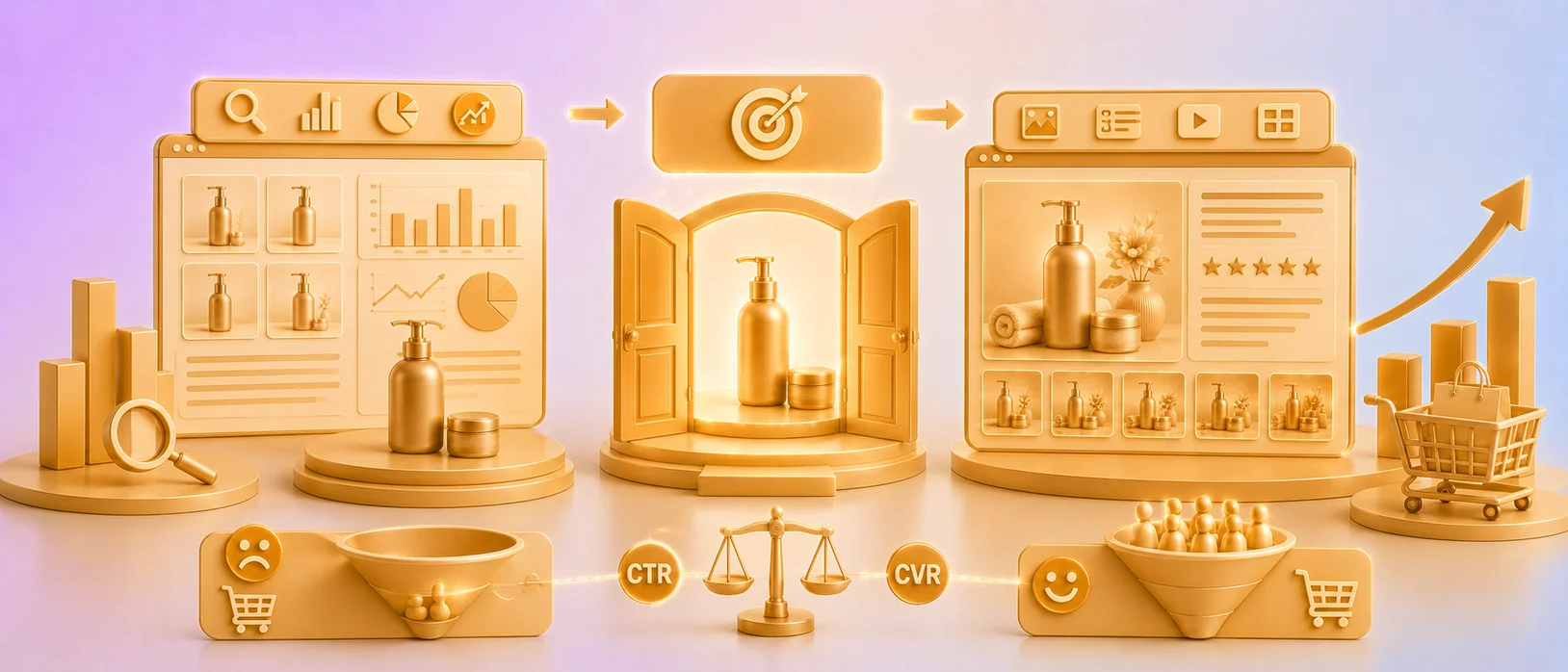
When two sellers offer the same product at a similar price, Amazon's algorithm doesn't pick a winner — buyers do, through CTR and CVR. The listing that earns more clicks and converts more sessions sends Amazon a stronger demand signal, climbs organic rank, and gets more free traffic. The weaker listing pays more in PPC to compete and slowly loses ground.
So the "winning product" doesn't win on its own. It wins for whichever seller built the listing that:
- Wins the click at thumbnail size on mobile (CTR).
- Converts the session by killing buyer objections (CVR).
- Holds rank through velocity, lowering ACOS over time.
"Traffic comes in, sales don't."
What happens when you pick a winning product and build a losing listingThe demand your research found is real — the traffic shows up — but it converts for the competitor with the better listing, not for you. You validated the product and lost it at the listing.
The Validation Math: Demand Without Conversion Is Worthless
Run the numbers on a "winning product" two ways — a product doing 30,000 category sessions/month at $30 AOV:
The product research found the $126k opportunity; the listing determines whether you capture it or hand it to a competitor. And it compounds: the seller converting at 14% builds velocity, climbs rank, and pays less PPC, while the 8% seller bids harder to stay visible and watches ACOS eat the margin. Six months in, the better listing isn't 1.75× ahead — it's pulling away, because rank compounds.
"I'm bleeding money on PPC."
Often a product validated on demand but launched with a listing that couldn't convertThe PPC isn't the problem — it's exposing a conversion problem the seller didn't price in during research.
How to Pick a Product You Can Actually Win
Put it together. A practical validation checklist that includes the listing factors most sellers ignore:
- Demand: stable/growing 12-month search trend, not a fad
- Competition: top sellers have beatable listings (weak mains, shallow infographics, missing A+)
- Margin: unit economics survive $2–5 PPC clicks to launch
- Differentiation: a feature/bundle/use-case/quality angle you can show in images
- Review gaps: competitor complaints you can address and visualize
- TOS: no claim minefield or gating you can't navigate
- Listing plan: you know what your main image and 7-image set will prove before you order inventory
That last line is the one that separates sellers who win from sellers who gamble. Plan the listing during research, not after the inventory lands. The differentiation angle you'll show should be decided before you commit capital — because if you can't show why you're better, demand alone won't save you.
Don't Validate the Product and Wing the Listing
"Hired someone on Fiverr for $80. The images looked nice but my conversion actually dropped."
The most common new-seller mistakeSpend six weeks validating the product, then hand the listing to the cheapest option and undo the entire research effort. You did the hard analytical work to find a winnable product — and then handed the win to a competitor by building a listing that doesn't convert the demand you proved exists.
We're more expensive than Fiverr. But here's the framing that matters at launch: you're about to commit thousands to inventory based on a demand thesis. The listing is what converts that demand into sales. Under-investing in the listing after over-investing in the product is backwards. The listing is where your product research either pays off or doesn't.
This is loss aversion at the launch decision: you've already committed capital to inventory, and the fear of that not converting should drive the listing investment — because a winning product with a losing listing loses the capital you already spent.
The Bottom Line: Research Finds It, Design Wins It
Product research is necessary and you should do it well — demand, competition, margin, differentiation. But understand what it does and doesn't tell you. It finds the opportunity. It does not capture it. The listing captures it, by converting the traffic your research proved exists into the sales that build rank and pay back PPC.
The sellers who win on Amazon aren't just better at finding products. They're better at winning them — and winning happens at the listing, where CTR and CVR turn a validated opportunity into an actual business.
FAQ
- How do I find a winning product to sell on Amazon?
- Validate five factors: durable 12-month demand (not a fad), competition with beatable listings, margin that survives $2–5 PPC clicks, a differentiation angle you can show in images, and no TOS minefield. Crucially, include a listing teardown of top competitors — weak mains, shallow infographics, or missing A+ Content signal an opening you can win with a better listing.
- Why does my listing matter as much as the product I choose?
- Because when two sellers offer the same product at a similar price, buyers pick the winner through CTR and CVR — not the algorithm. The listing that wins more clicks and converts more sessions sends Amazon a stronger demand signal, climbs rank, and gets more free traffic. A winning product with a losing listing loses the opportunity to a competitor with a better one.
- Can product research tools tell me if I'll win a niche?
- Only partially. Helium10 and Jungle Scout show demand and competition numbers, but they can't show which listing converts the traffic — the factor that actually decides the sale. You have to do a manual listing teardown of top competitors to judge whether their images and A+ are beatable, which determines whether the niche is winnable for you specifically.
- How much does the listing affect a product's sales?
- Dramatically. On a product doing 30,000 monthly sessions at $30 AOV, the difference between a 14% and 8% conversion rate is roughly $54,000/month — same product, same demand, same price, decided entirely by listing quality. And it compounds: the better-converting listing builds velocity, climbs rank, and pays less PPC over time.
- Should I plan my listing before or after sourcing the product?
- Before. Decide the differentiation angle you'll show in your main image and 7-image set during product research, not after inventory lands. If you can't articulate and visualize why your product is better than the cheapest competitor before you commit capital, demand alone won't convert — and you'll have validated a product you can't actually win.
Found your product? Make sure the listing wins it. Free.
Send your ASIN (or product photos pre-launch) — we'll build your main image at no cost: mobile-first, TOS-compliant, built to win the click and convert the demand your research found. You see it before you commit to a full set. If it doesn't beat your top competitor in a PickFu A/B, you owe nothing.
Claim my free image →