

Supplements are the hardest niche on Amazon to win. Thousands of near-identical bottles, the same white-and-gold label aesthetic, the same "third-party tested" badge, and PPC costs that make grown sellers cry. Cost-per-click in core supplement keywords routinely runs $2–5+, which means a mediocre CVR doesn't just hurt — it bankrupts the unit economics.
"I spent $5k on PPC last month and broke even. Realized my main image looks like trash next to competitors."
Amazon seller forumIn supplements, that's not an occasional bad month — it's the default state for anyone whose listing doesn't out-convert the niche leader. When clicks cost $3 and your CVR is 8% while the leader's is 16%, you're paying double their cost per acquisition for the same sale. You can't out-bid that. You out-convert it. Here's the design playbook for a saturated niche.
Why Supplements Punish Weak Listings Harder Than Any Other Category
Three forces stack against you, and they all route through CVR:
- CPC is brutal. $2–5+ per click means every non-converting session is an expensive loss. In a $0.50-CPC category an 8% CVR is survivable; in supplements it's a slow bleed-out.
- Visual parity is the norm. Most supplement listings look identical — same bottle render, same label, same generic "benefits" icons. When everything looks the same, nothing converts above baseline, and the buyer defaults to price or reviews.
- Trust is the entire purchase. Buyers are putting this in their body. Every doubt — "is it safe, is it dosed right, will it actually work, is this brand legit" — is a conversion blocker that images either kill or leave standing.
The compounding effect: high CPC + low differentiation + high buyer doubt = the category where listing design has the highest CVR leverage on Amazon. A CVR lift that's nice-to-have in a cheap-CPC niche is survival-critical in supplements. That's also why supplement sellers have the highest willingness to pay for a listing that works — the math forces it.
The Comparison That Decides the Sale: You vs the Niche Leader
Open your top keyword on mobile right now. Put your tile next to the category leader's. In a saturated niche, the buyer is doing exactly this comparison in their head, in about 1.2 seconds, before they ever read an ingredient.
"A competitor with a worse product is outranking you. Want to know why?"
In supplements, the answer is never the formulaIn supplements, the answer is almost never the formula — buyers can't evaluate your formula from a tile. It's that the leader's listing signals trust, efficacy, and "real brand" faster than yours does. Same active ingredients, same dosage, but their tile says "buy with confidence" and yours says "generic bottle #4,000." The product is irrelevant if the listing loses the 1.2-second comparison.
Here's what the niche leader's tile is doing that yours probably isn't:
- Instant category clarity — the buyer knows exactly what it is and what it's for at thumbnail size.
- A trust signal in the image itself — within TOS, through design cues that read as established and credible, not text-stuffed.
- A "real brand" read — clean, consistent, confident, not a Canva template with a stock bottle.
- Differentiation from the wall of identical tiles — something that makes the eye stop without violating TOS.
You don't beat the leader by looking different for the sake of it. You beat them by killing buyer doubt faster than they do.
The Supplement Image Stack That Converts
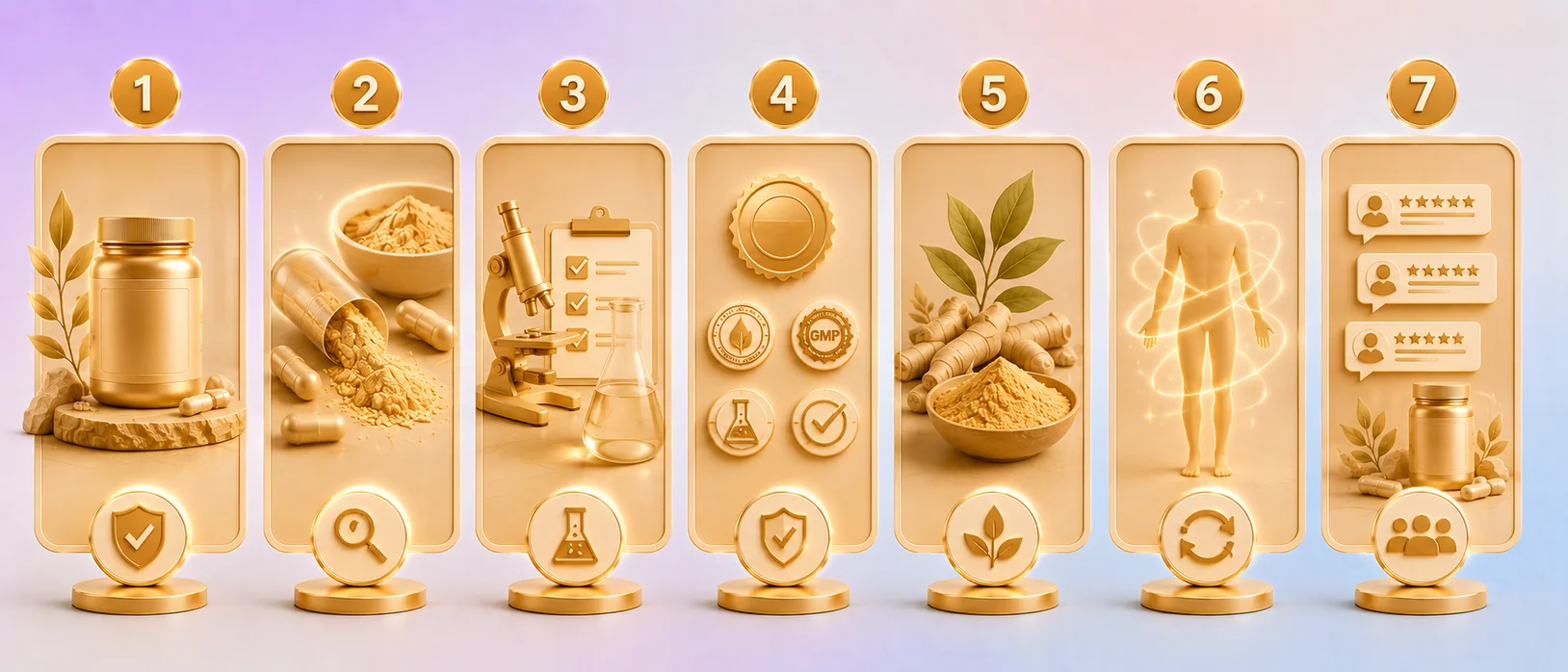
Each slot does a specific job — and in supplements, that job is almost always defusing a trust objection. Build this:
TOS-compliant (pure white, 85%+ fill, no text/badges), mobile-readable, one clear focal point. The bottle has to look like an established brand's bottle, not a generic render. This earns the click against a wall of look-alikes.
Not "supports immune health" in tiny text — the outcome the buyer wants, shown with conviction. Lead with what they're actually buying: better sleep, more energy, recovery, focus.
Buyers want to verify they're getting a real, effective dose — not under-dosed filler. Show the key actives and dosage clearly. Transparency is a conversion lever in supplements; hiding it reads as something to hide.
The single biggest supplement objection: "is this safe and what it claims?" Show testing, manufacturing standards (GMP, FDA-registered facility), certifications. This is the trust image that closes the safety-conscious buyer.
A comparison infographic (no named competitors — TOS): your dosage, bioavailability, form, or purity vs the standard cheap version. Buyers comparison-shop supplements obsessively; do the comparison for them.
Defuse "how do I take it" and "when will it work." Clear usage and realistic timeline reduce both pre-purchase doubt and post-purchase returns.
Money-back guarantee, brand credibility, certifications restated. Close the buyer who's 90% there but needs one more reason to trust an unfamiliar brand with their body.
Every image kills a doubt. In supplements, doubt is the whole game — and the listing that resolves doubt fastest wins the CVR, which wins the ACOS math, which wins the niche.
A+ Content: Where Supplement Trust Is Won or Lost
If you have Brand Registry, A+ is non-negotiable in supplements — it lifts CVR 8–15% on average, and in a trust-driven category that lift skews higher. Build for conviction:
- Comparison chart — your formula/dosage vs the value tier. Supplement buyers live on comparison.
- Ingredient/efficacy modules — what each active does, why your dose matters, sourcing quality.
- Trust module — testing, GMP, certifications, guarantee. The credibility that an unfamiliar bottle desperately needs.
- Usage module — protocol and expected timeline.
Skip the brand-mission poetry. In supplements, A+ is a trust-building machine, and trust is what stands between a $3 click and a converted sale.
The ACOS Math That Makes This Urgent
This is the calculation that should drive every supplement seller's decision:
Same bid, same traffic, same product. A CVR lift from 8% to 14% cuts your cost per acquisition by 43% — which collapses your ACOS and turns a break-even campaign into a profitable one. On a $5k/mo PPC budget, that's the difference between bleeding and banking.
"Burning PPC, ACOS is climbing."
In supplements, almost always a CVR problem in disguiseIn supplements, climbing ACOS is almost always a CVR problem wearing an ad-spend costume. You cannot bid your way to profitability in a $3-CPC niche with a weak listing — you're just paying more for the same leak. The listing is the lever. Fix CVR and the entire PPC economics flip.
This is loss aversion at category-extreme intensity: in supplements, every bounced paid session is a $3 loss you've already booked, repeated thousands of times a month. That leak feels brutal because it is brutal — and it's fixable at the listing, not the bid.
"Got Cases in My Category?" — Why Niche Specialization Matters Here
"Got cases in my niche?"
Supplement sellers ask this harder than anyoneSupplement sellers ask this harder than anyone, because the category has real rules: TOS limits on health claims, FDA-language landmines, the specific trust signals that convert in supplements vs the ones that get you flagged. A generalist designer who's never built a supplement listing will either make a pretty bottle that doesn't convert, or — worse — add a non-compliant health claim that gets the listing suppressed.
"Hired someone on Fiverr for $80. The images looked nice but my conversion actually dropped."
Amazon seller forumIn supplements, the Fiverr trap is doubled: the generalist doesn't know supplement-specific TOS (health claims, disease claims, "FDA-approved" language that's prohibited), and they don't know which trust signals actually move a supplement buyer. Nice-looking and non-converting, or nice-looking and suppressed.
We're more expensive than Fiverr. In a $3-CPC niche where CVR is the whole ballgame, the comparison isn't $80 vs a package price — it's $80 vs the cost-per-acquisition collapse a converting listing delivers. At supplement economics, a listing that lifts CVR 6 points pays for itself in days and prints margin every month after.
FAQ
- Why is supplement listing design so important on Amazon?
- Supplements combine the highest PPC costs on Amazon ($2–5+ CPC), extreme visual parity (most bottles look identical), and trust-driven purchases (buyers are ingesting the product). That stack makes CVR the deciding factor — a weak listing means paying double the niche leader's cost per acquisition for the same sale — so listing design has the highest CVR leverage of any category.
- How do I make my supplement listing convert better than competitors?
- Build images that kill trust objections faster than the niche leader: a TOS-compliant main that signals an established brand, a hero-benefit image leading with the outcome, a clear dosage/Supplement Facts image, a third-party testing/quality image, a comparison infographic, a how-to-use image, and a trust/guarantee cue — plus conversion-focused A+ Content with comparison and credibility modules.
- What trust signals convert supplement buyers?
- Third-party testing, GMP and FDA-registered facility standards, transparent dosage and Supplement Facts, certifications, and a money-back guarantee. Because supplement buyers are ingesting the product, every visible credibility cue lowers purchase doubt and lifts CVR — provided it follows Amazon TOS and avoids prohibited disease or "FDA-approved" claims.
- How does a better supplement listing lower my ACOS?
- ACOS is driven by cost per acquisition, which is CPC ÷ CVR. At a $3 CPC, lifting CVR from 8% to 14% cuts cost per acquisition from $37.50 to $21.43 — a 43% reduction — on the same bids and traffic. In high-CPC supplement keywords, improving the listing is the most powerful ACOS lever available because you can't bid your way to profit with a weak CVR.
- Can a generalist designer make my supplement listing?
- It's risky. Supplements have category-specific TOS rules — prohibited health and disease claims, banned "FDA-approved" language — that generalists routinely violate, triggering suppression. They also don't know which trust signals actually convert supplement buyers. A specialist with supplement-category experience reduces both the suppression risk and the conversion miss.
Win the 1.2-second comparison against your niche leader. Free.
In a niche this saturated, your main image is your single biggest CVR lever — and the cheapest to test. Send your ASIN — we'll rebuild your main image at no cost: TOS-compliant (including supplement-specific rules), mobile-first, built to win the 1.2-second comparison against your niche leader. If it doesn't beat your current image in a PickFu A/B against the category leader, you owe nothing.
Claim my free image →