
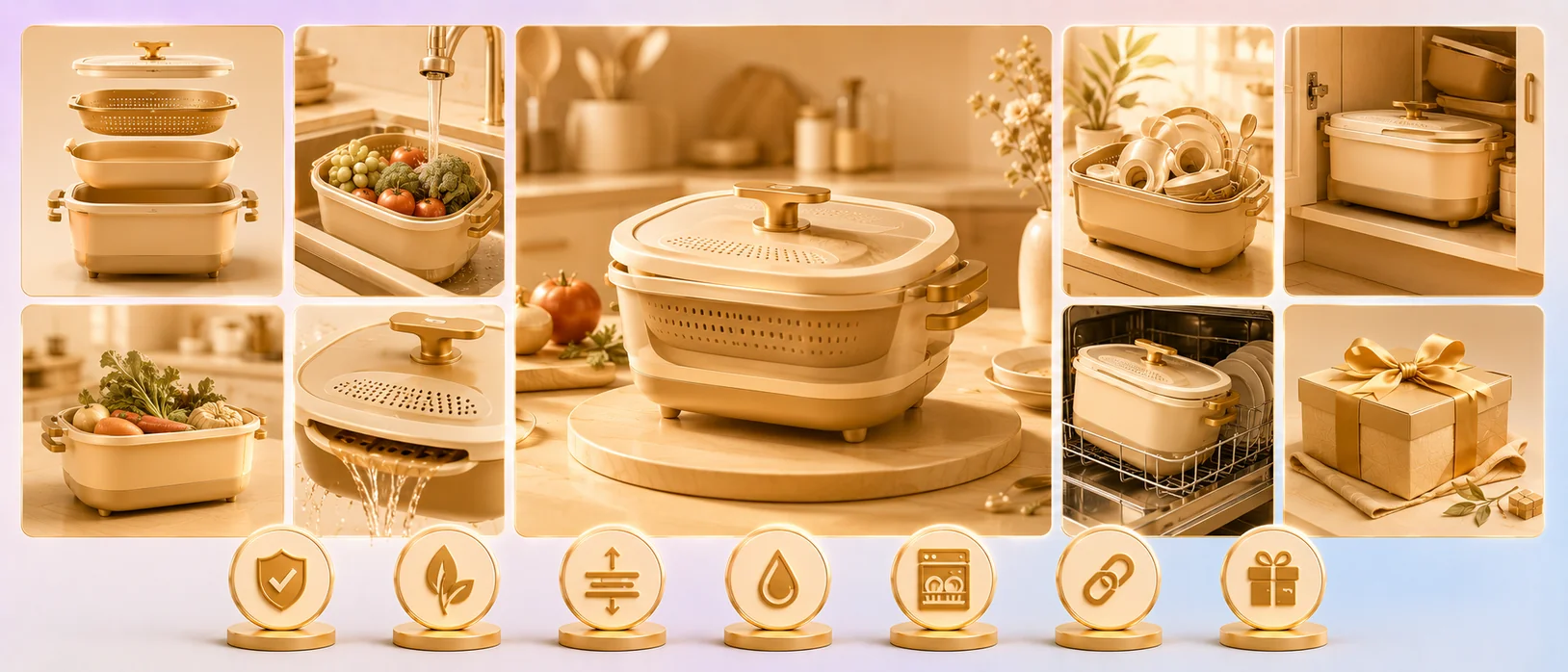
Kitchen & Home is the most crowded category on Amazon. Search "garlic press" or "storage container" and you get a wall of near-identical tiles — same product, same angle, same white background, same price band. In that wall, your image isn't competing on quality. It's competing for the click, in about 1.2 seconds, on a phone.
"A competitor with a worse product is outranking you. Want to know why?"
In Kitchen & Home, the answer is almost always the imagesThe category is too saturated for product quality to surface on its own — the buyer can't evaluate your build from a thumbnail. They click the tile that reads fastest and trust the listing that resolves their doubts in the swipe. Here's exactly what makes buyers click and convert in this category, and how to beat the niche leader on both.
Why Kitchen & Home Punishes Generic Listings
This category has a specific problem: visual sameness. Three forces make it brutal:
- Everyone uses the same template. White background, product at 45°, maybe a hand for scale. When every tile looks identical, none of them earn an above-baseline click, and the buyer falls back to price and review count.
- The products are hard to differentiate at a glance. A $12 storage container and a $28 storage container look identical at thumbnail size. The buyer can't see your better seal, thicker walls, or lifetime warranty — unless your images show it.
- Huge buyer volume, huge competition. Massive search volume means real money is moving, which means every competitor with a refresh budget is fighting for the same clicks. A competitor who updates their images can take your rank in a week.
"Competitor just refreshed and now ranks above me."
In Kitchen & Home it happens constantlyIt happens constantly because the bar to stand out is low — most listings are generic, so a single well-built tile leapfrogs the field. The flip side: that's also your opening. In a category this generic, a listing built to convert doesn't need to be extraordinary. It needs to be clearly better than the wall, which most sellers never bother to be.
The 1.2-Second Click Test: You vs the Niche Leader
Open your top keyword on mobile. Put your tile next to the category leader's. The buyer is making this exact comparison, and the tile that wins does these things faster than yours:
- Instant product clarity — what it is, no ambiguity, at thumbnail size.
- Scale you can read — Kitchen & Home buyers obsess over size ("will it fit my cabinet / my hand / my counter"). The tile that communicates scale wins the click and pre-qualifies the buyer, lifting CVR.
- A "real brand" signal — not a generic render, but a product that looks like it belongs to an established brand.
- One thing that breaks the wall — an angle, a context cue, a focal point that stops the scroll without violating TOS.
Beating the niche leader isn't about a prettier photo. It's about reading faster and resolving more doubt per image than they do.
What Makes Kitchen & Home Buyers Click (and Then Buy)
This category has category-specific conversion drivers. Build to them:
TOS-compliant (pure white, 85%+ fill, no text/badges), mobile-readable, one focal point. In Kitchen & Home, the main also has to telegraph scale and material quality through the shot itself — a buyer should sense "sturdy, well-made, right size" before reading a word. This is what separates the click-winner from the wall.
Kitchen & Home is one of the categories where lifestyle imagery converts hardest, because the buyer is imagining the product in their space. Show it on a real counter, in a real cabinet, in a real kitchen — at correct scale. This is where the buyer decides "yes, this fits my life." Allowed on images 2–7 (not the main).
The #1 Kitchen & Home objection and the #1 return driver: size. Show exact dimensions against a recognizable reference. "Holds 2L," "fits standard shelves," "16-inch handle." Removing size uncertainty directly lifts CVR and slashes returns — which protects your account health and BSR.
The buyer can't feel your product through the screen. Show the thickness, the finish, the material grade, the seal, the join — whatever justifies your price over the $12 version. This is how you convert the buyer comparing you to the generic.
A comparison infographic (no named competitors — TOS): your capacity, durability, materials, or features vs the value tier. Kitchen & Home buyers comparison-shop relentlessly; do the comparison for them on the page.
Kitchen & Home products often have multiple uses. Show them. "Microwave, freezer, dishwasher safe." "Works for X, Y, and Z." Versatility is a conversion multiplier — more use cases, more reasons to buy.
Warranty, guarantee, certifications, an established-brand cue. Close the buyer who's 90% there.
Each image kills a specific doubt. In a category where the products look identical, the listing that resolves doubt fastest wins the CVR — and the CVR wins the ACOS math.
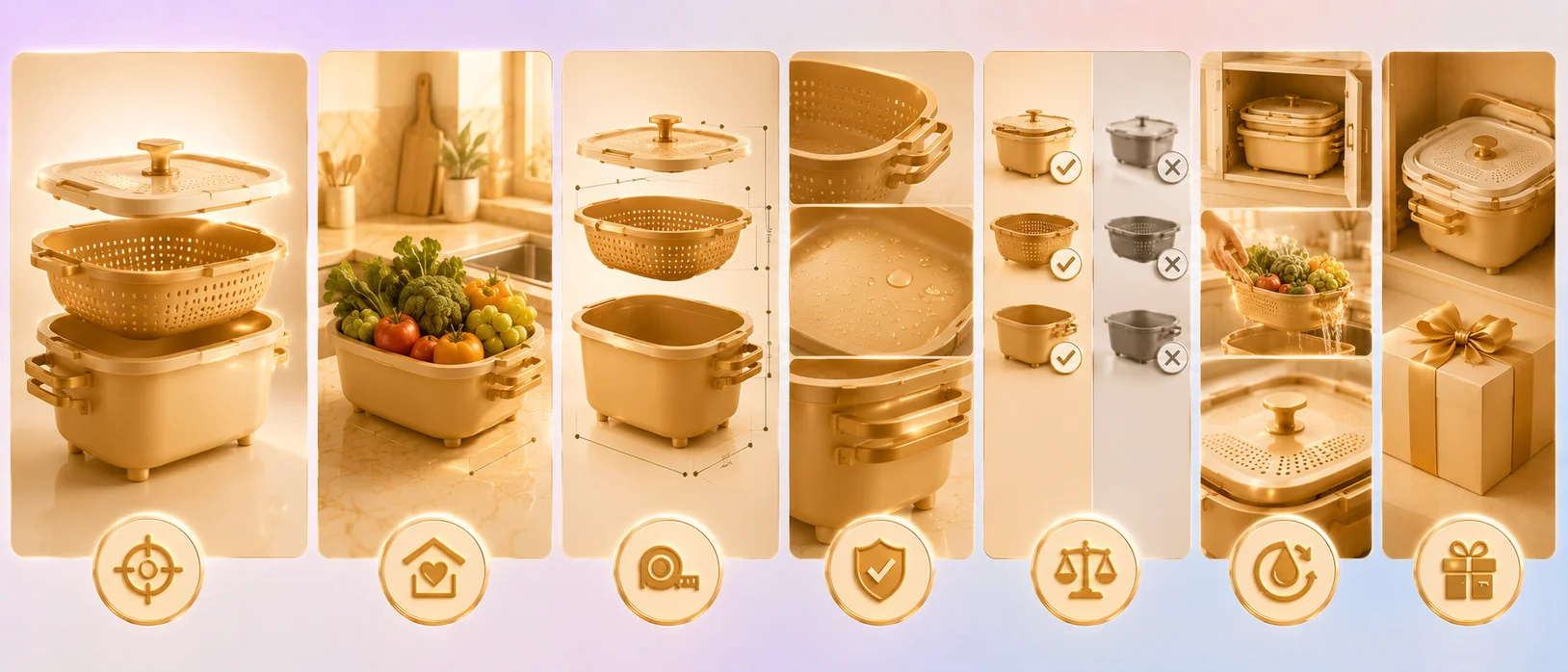
The Case: What a Refresh Actually Moves in Kitchen & Home
We've shipped listings in Home and Kitchen, and the pattern is consistent. Take a representative example — a kitchen storage SKU doing 25,000 sessions/month at $26 AOV, stuck at 9% CVR, ACOS climbing past 35% because PPC was propping up a listing that didn't convert.
The audit found the usual Kitchen & Home failures: a main image that didn't communicate scale, no in-context lifestyle shot, no explicit dimensions, and a comparison the buyer had to make in their head. The listing was generic in a generic category — invisible.
The refresh: scale-forward main, an in-context lifestyle image at correct size, explicit dimensions, a material-quality image, and a comparison infographic. Result pattern in this category: CVR moving from ~9% toward 13–15%, which on 25k sessions at $26 AOV is +$27k–$39k/month on the same traffic — plus the ACOS relief from a listing that finally converts the paid clicks it was already buying.
"Traffic comes in, sales don't."
In Kitchen & Home, almost always solved at the image levelIn Kitchen & Home, that sentence is almost always solved at the image level, because the traffic is there — the category has volume — and the leak is conversion. Fix the images, plug the leak.
The ACOS Connection (Why This Pays for Itself)
Kitchen & Home CPCs aren't supplement-brutal, but the category's competition keeps them meaningful, and the math is the same:
- Higher CVR → each PPC click more likely to convert → lower cost per acquisition → lower ACOS.
- Lower ACOS → room to bid for profitable traffic → more converting sessions → stronger velocity → higher organic rank and BSR.
- Higher rank → more free traffic → less PPC dependence.
"Burning PPC, ACOS is climbing."
You can't out-bid a generic listing in a crowded categoryYou can't out-bid a generic listing in a crowded category — you just pay more for the same low conversion. The images are the lever that flips the economics. This is loss aversion in plain numbers: every bounced paid session in a high-volume category is a booked loss repeated thousands of times a month, and it's fixable at the listing, not the bid.
Why Fiverr Keeps You Generic
"Hired someone on Fiverr for $80. The images looked nice but my conversion actually dropped."
Amazon seller forumIn Kitchen & Home, the Fiverr trap is staying generic. A generalist gives you the same white-background, 45°-angle template as everyone else — a nice-looking tile that's indistinguishable from the wall, so it doesn't win the click. Worse, they don't know the category's specific conversion drivers (scale obsession, in-context lifestyle, material proof) or the TOS rules that keep the main compliant.
We're more expensive than Fiverr. The Kitchen & Home math: a CVR lift from 9% to 14% on a 25k-session SKU is roughly $30k+/month on the same traffic. A full image-set rebuild ($600–$1,200 from a specialist with category cases) pays back in days and compounds through lower ACOS and higher rank. In a category this generic, the cost of looking like everyone else is the whole opportunity you're leaving on the table.
FAQ
- What makes Amazon Kitchen & Home product images convert?
- Category-specific drivers: a scale-forward TOS-compliant main image that telegraphs size and build quality, an in-context lifestyle image showing the product in a real kitchen or home at correct scale, explicit dimensions, a material/build-quality image, a comparison infographic vs the generic version, and versatility/use-case imagery. In a saturated category, the listing that resolves buyer doubt fastest wins CTR and CVR.
- Why is my Kitchen & Home listing not selling despite traffic?
- Kitchen & Home has high search volume, so traffic is usually present — the leak is conversion. The category's visual sameness means generic listings don't convert above baseline; if your images don't communicate scale, material quality, and in-context fit, buyers bounce. "Traffic comes in, sales don't" in this category is almost always an image problem.
- Does lifestyle photography help Kitchen & Home listings?
- Yes — Kitchen & Home is one of the categories where lifestyle imagery converts hardest, because buyers are imagining the product in their own space. In-context shots on a real counter, shelf, or kitchen at correct scale help buyers decide "this fits my life," lifting CVR. Lifestyle belongs on images 2–7, never the TOS-restricted main image.
- How important is showing scale in Kitchen & Home images?
- Critical. Size is the #1 buyer objection and the #1 return driver in the category ("will it fit my cabinet / counter / hand"). Showing exact dimensions against a recognizable reference both lifts CVR (the buyer pre-qualifies) and cuts returns (fewer "smaller than expected" disappointments), which protects account health and BSR.
- Why do competitors with worse products outrank me in Kitchen & Home?
- Because in a saturated category buyers can't evaluate product quality from a thumbnail — they click the tile that reads fastest and convert on the listing that resolves doubt best. A competitor with a worse product but better images wins the CTR and CVR, which drives sales velocity and organic rank above you regardless of actual product quality.
Stop blending into the wall. Get your first image free.
In Amazon's most crowded category, your main image is the difference between winning the click and blending into the wall — and it's the cheapest asset to test. Send your ASIN — we'll rebuild your main image at no cost: scale-forward, mobile-first, TOS-compliant, built to beat your niche leader's tile. If it doesn't beat your current image in a PickFu A/B against the category leader, you owe nothing.
Claim my free image →