
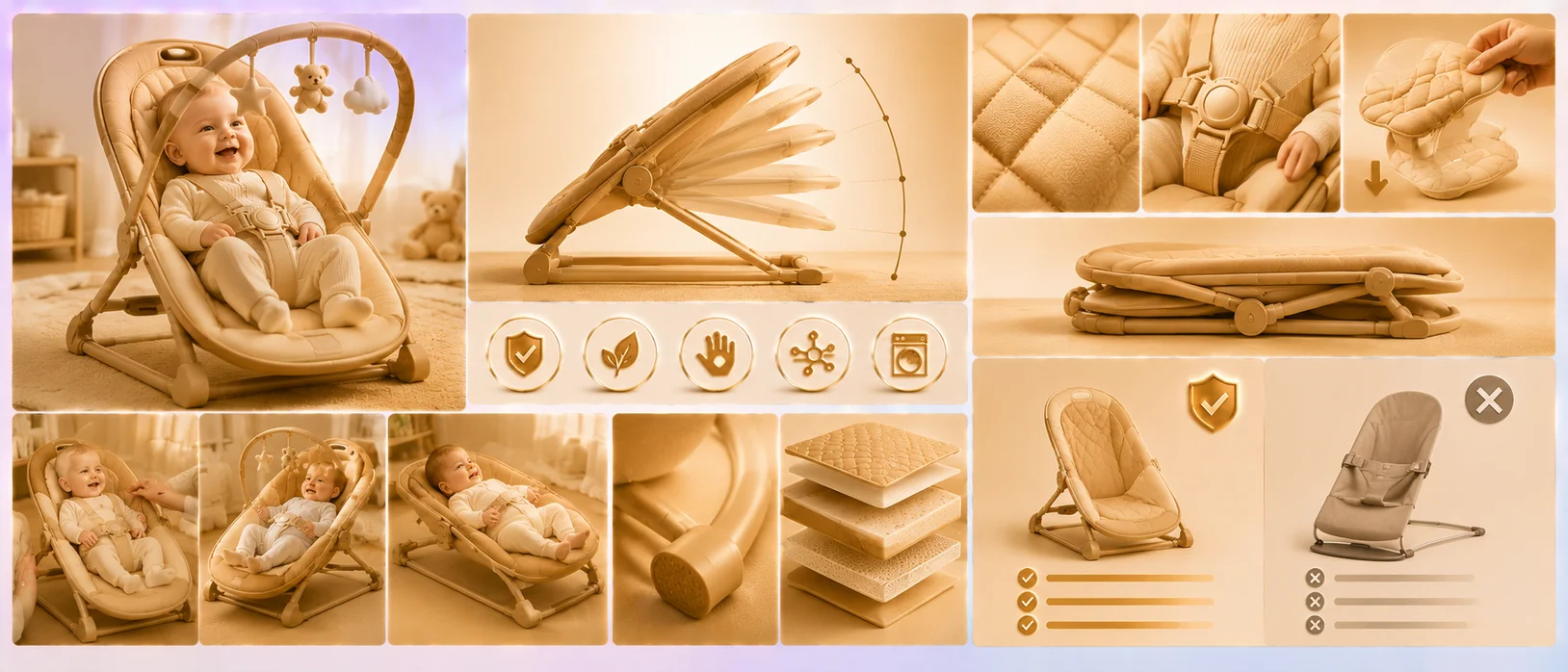
In Baby, a parent isn't buying a product — they're protecting their child. That single fact changes everything about how the listing has to work. Every image is judged against one silent question: "Is this safe for my baby?" A listing that answers it converts. A listing that leaves it hanging loses the sale, no matter how good the product actually is.
"Look like a real brand, not a no-name."
In Baby, the JTBD is about safetyIn Baby, that job-to-be-done isn't about prestige — it's about safety. A parent will not trust their infant's wellbeing to a listing that looks like a generic, anonymous, slapped-together no-name. Trust is the conversion mechanism here, and trust is signaled visually before a single word of copy is read. Here's how to build baby listings that earn it.
Why Trust Is the Entire Conversion Equation in Baby
Most categories convert on benefit or price. Baby converts on trust, and the reasons are specific:
- The stakes are maximal. A parent buying a baby product is risk-averse to the extreme. Any doubt about safety, materials, or quality doesn't just lower CVR — it kills the sale outright. There's no "good enough" when it's their child.
- The buyer can't verify safety through the screen. They can't feel the material, test the buckle, or confirm it's non-toxic. So they substitute the only available signal: how safe and credible the listing looks.
- Emotional + high-research buying. Parents both feel intensely and research obsessively. They read every spec, check every certification, compare every listing. The listing that proves safety thoroughly wins; the one that hand-waves it loses.
The strategic point for a brand manager: in Baby, trust-building isn't a soft, brand-y nice-to-have. It's the hard conversion lever. Every safety proof you show is a doubt removed, and every doubt removed is CVR gained. A baby listing that doesn't systematically build trust is leaving conversion — and the premium price safety justifies — on the table.
The DTC-to-Amazon Gap in Baby
If you're a brand manager bringing a DTC baby brand onto Amazon, here's the specific trap.
"These guys actually get Amazon."
The gap is platform context, not tasteYour DTC baby creative is warm, emotional, beautifully shot — a sleeping baby, soft light, your brand story about being founded by parents. It works on your site because the buyer is already in your world and already trusts you. On Amazon, the parent is mid-comparison, on a phone, scanning competing listings, and they don't trust you yet. Your emotional hero shot does brand work when the Amazon buyer needs safety proof work.
The gap isn't taste — your team has plenty. It's platform context: knowing that an Amazon baby buyer needs certifications shown, materials proven, dimensions clear, and safety standards visible in the image carousel, because that's where they make the trust decision. The emotional brand layer stays; the safety-proof conversion layer gets added on top. That's the difference between a baby listing that looks lovely and one that converts a risk-averse parent at scale.
What Builds Trust in a Baby Listing (Image by Image)
Trust is built through specific, visible proof — not a warm feeling. Build this stack:
TOS-compliant (pure white, 85%+ fill, no text/badges), mobile-readable. In Baby, the main has to telegraph quality and legitimacy through the product itself — a parent's eye filters hard for "real brand, not sketchy no-name." This earns the click and sets the trust baseline before anything else.
The highest-converting Baby image: visible safety credentials. CPSIA compliance, ASTM standards, non-toxic/BPA-free, lead-free, JPMA certification — whatever applies to your product. This is the image that directly answers "is it safe?" and it's the one generic listings skip, leaving the sale uncaptured.
Parents scrutinize materials. Show exactly what touches their baby: organic cotton, food-grade silicone, non-toxic finishes. Transparency about materials is trust — hiding it reads as something to hide.
"Is this right for my baby's age/size?" Show the size chart, age range, weight range, dimensions against a clear reference. Getting this right lifts CVR (the parent self-qualifies) and cuts returns — critical for account health and BSR.
Show the product used correctly and safely with a baby (or a realistic stand-in), demonstrating proper, secure use. This proves the product works as intended and reassures the parent it's straightforward and safe to use.
A comparison infographic (no named competitors — TOS): your safety features, materials, certifications, or build vs the value tier. When a parent sees why you're safer/better than the cheaper option, the price gap justifies itself.
Money-back guarantee, brand story as trust signal (founded by parents, tested by pediatricians if TOS-compliant and true), certifications restated. Close the parent who needs one final reassurance.
Every image removes a safety doubt. In Baby, the listing that proves safety most thoroughly converts the risk-averse parent — and that conversion, at the premium safety justifies, is the whole game.
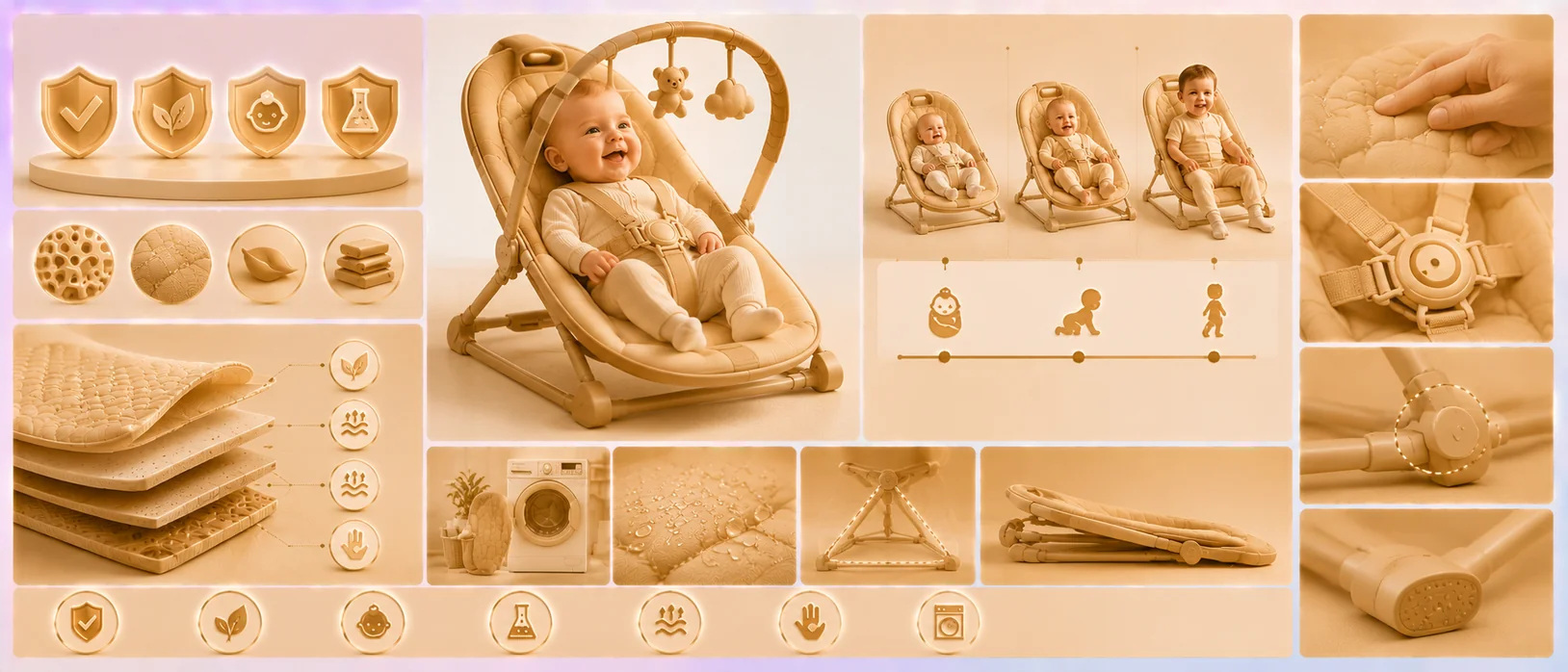
A+ Content: Where Baby Trust Is Cemented
If you have Brand Registry, A+ is where a risk-averse parent does final due diligence — and where you bank the 8–15% CVR lift. In Baby, build for trust depth:
- Safety/certification module — all standards and credentials, expanded and clear.
- Materials module — what it's made of, why it's safe, sourcing quality.
- Comparison chart — your safety/materials vs the value tier.
- Brand credibility module — your story framed as trust (parent-founded, rigorously tested), not just sentiment.
A baby brand's A+ that proves safety thoroughly is what converts the parent who's been comparing six listings and needs to feel certain about one. This is where brand equity finally does conversion work.
The Case: What Trust-Proof Images Move in Baby
We've shipped listings in Baby/Home, and the pattern holds. Take a representative example — a baby brand launching a feeding product at $32 (premium, safety-positioned) but with DTC-style emotional imagery dropped into Seller Central: a beautiful lifestyle main, a warm brand-story carousel, but no visible certifications, no materials breakdown, no safety standards. Early CVR stuck at 7%, ACOS climbing past 40% because the premium price wasn't backed by visible proof of the safety it claimed.
The parent's read: "$32 for a feeding product that doesn't show me a single safety certification? The $14 one at least has a BPA-free badge." The premium price and the proof-free listing were fighting each other.
The refresh: a real-brand-signaling main, a safety-certifications image, a materials breakdown, an age/size fit image, and a comparison vs the generic. Result pattern in Baby: CVR moving from ~7% toward 12–14%, which at a $32 AOV is a major revenue swing — and crucially, it let the brand hold the premium price the safety positioning required. On a launch doing 15k sessions/month, that's the difference between a trusted brand and a stalled one.
"Traffic comes in, sales don't."
In Baby, usually the listing isn't proving safetyIn Baby, that sentence usually means the listing isn't proving safety — the parent arrives, doesn't find the reassurance they need, and leaves for a listing that provides it. Prove safety, earn trust, convert.
The ACOS + Trust Connection
Baby has competitive CPCs and trust-sensitive buyers, which makes the CVR math powerful:
- Higher CVR → lower cost per acquisition → lower ACOS on the same bids.
- A trusted, safety-proven listing → parents accept the premium safety justifies → higher AOV.
- Together → a trust-built listing lifts both the rate and value of conversion → stronger velocity → higher BSR → less PPC dependence.
"Burning PPC, ACOS is climbing."
At a premium price, often the listing isn't earning the trust the price requiresIn Baby, climbing ACOS at a premium price often means the listing isn't earning the trust the price requires. You can't bid your way to profit when parents don't trust the listing enough to convert. Visible safety proof is the lever that turns expensive clicks into converted, confident purchases.
This is loss aversion working on both sides: the parent's extreme loss-aversion about their child's safety means any unproven doubt loses the sale, and every bounced paid session is a booked loss on traffic you paid for.
Why Generic Design Fails Baby Worse Than Any Category
"Hired someone on Fiverr for $80. The images looked nice but my conversion actually dropped."
Amazon seller forumIn Baby, generic design doesn't just underperform — it actively breaks the trust the entire purchase depends on. A generalist makes nice-looking baby images that skip the certifications, hand-wave the materials, and miss the safety proof a risk-averse parent requires. Worse, they don't know Baby's TOS landmines (safety-claim rules, prohibited language) and can introduce a non-compliant claim that suppresses the listing. Nice-looking and untrusted converts a parent at near zero.
We're more expensive than Fiverr. For a brand manager in Baby, the comparison isn't $80 vs a package — it's $80 vs the trust you forfeit and the premium price you can't hold without it. A baby listing built to prove safety pays for itself in held price and lifted CVR, on every unit, because trust is the one thing a parent won't compromise on and the one thing generic design can't fake.
FAQ
- What makes a baby product listing convert on Amazon?
- Visible trust and safety proof. Baby buyers are extremely risk-averse — they're protecting their child — so the listing must answer "is this safe?" through certifications (CPSIA, ASTM, BPA-free), materials transparency, clear age/size fit, and safe-use demonstration. A real-brand-signaling main image plus a safety-proof carousel and certification-rich A+ Content build the trust that converts.
- Why is trust so important in the baby category on Amazon?
- Because parents can't verify safety through the screen and the stakes are maximal — any doubt about safety or materials kills the sale outright. Parents substitute the listing's perceived safety and credibility for hands-on verification, so visible trust signals (certifications, materials, standards) are the direct conversion lever, not a soft branding nicety.
- What safety information should baby product images show?
- The certifications and standards that apply to your product (CPSIA compliance, ASTM, JPMA, BPA-free, lead-free, food-grade/non-toxic materials), a clear materials breakdown of what touches the baby, accurate age/size/weight fit, and safe-use demonstration. These directly answer the "is it safe?" question that decides the purchase — provided they follow Amazon TOS and are truthful.
- Should I reuse my DTC baby brand photography on Amazon?
- Not directly. DTC emotional and lifestyle imagery works on your own site where the parent already trusts you, but on Amazon they're mid-comparison and don't trust you yet — they need visible safety proof (certifications, materials, standards) in the image carousel. Keep the brand layer, but add the safety-proof conversion layer and ensure TOS-compliant claim language.
- How does a trust-built baby listing affect price and ACOS?
- Proven safety lets you hold the premium price that safety positioning commands (higher AOV) while lifting CVR, which lowers cost per acquisition and ACOS on the same bids. A trust-built listing raises both the rate and value of conversion — compounding into stronger velocity and higher BSR — whereas a proof-free listing forces price competition against cheaper, lower-trust alternatives.
Set the safety baseline that converts risk-averse parents. Free.
In a category where trust is the entire conversion equation, your main image sets the safety baseline — and it's the cheapest asset to test first. Send your ASIN — we'll rebuild your main image at no cost: real-brand-signaling, safety-first, mobile-first, TOS-compliant (including Baby claim rules). If it doesn't beat your current image in a PickFu A/B against your category leader, you owe nothing — and you'll see how the same trust-building approach carries through your full safety-proof carousel.
Claim my free image →